
Airway infections pose a risk for people with COPD. Lung specialist Prof. Rainald Fischer explains why and shares how patients with COPD can avoid catching colds.

People with chronic obstructive pulmonary disease (COPD) are particularly vulnerable to respiratory infections. These infections not only have the potential to cause lasting damage to lung function, but in some cases can also result in serious complications such as heart attacks or strokes. In this interview, lung specialist Prof. Rainald Fischer explains the reasons behind this and what steps COPD patients can take to protect themselves from colds and respiratory infections.
Prof. Fischer: Respiratory infections can be particularly serious for people with COPD. Unfortunately, a patient with a serious respiratory infection is at an increased risk of dying in the weeks and months following the infection. Even milder respiratory infections can increase the health risk. COPD patients should therefore avoid any respiratory infection wherever possible.
Prof. Fischer: Firstly, the infections lead to severe exacerbations (flare-ups), which can cause a sudden worsening of symptoms and may also lead to a longer-term decline in lung health. In people with COPD, there is also the risk that respiratory infections may be accompanied by cardiac events such as heart attacks, strokes or cardiac arrhythmias, thereby further raising the risk of mortality.
Prof. Fischer: A stuffy nose or a mild cold are not inherently dangerous – provided they are confined to the upper airways, i.e. the nose, throat and larynx. However, in people with COPD there is always the risk that the infection may spread to the lower airways because the lungs are already affected by COPD. And it is when this happens that the infection can have serious health consequences.
In addition, it is not usually possible to treat viral infections with antibiotics for example. This makes it all the more important to avoid them in the first place – even if they initially appear to be harmless. What starts as just a simple cold can become serious in COPD patients and can cause lasting damage to the lungs.
Prof. Fischer: Patients cough more, are short of breath and feel that they are able to do less. Lung function tests, if performed, may show that the airways have become narrower. Blood tests may also show signs of increased inflammation. These changes can take several weeks to improve.
Even in people who do not have chronic lung disease, an infection of the lower airways can linger for up to four weeks – and even up to eight weeks in some cases. This means that the symptoms last a relatively long time and it is during this time that patients with COPD tend to develop additional cardiovascular diseases.
Prof. Fischer: It is assumed that COPD as a disease is not confined solely to the lungs, but that the inflammation in the airways may also lead to heightened inflammation throughout the body. These inflammatory responses can also affect the heart region and result in changes to the heart. The inflammatory activity can, for instance, promote the development of blood clots, which may in turn result in a heart attack.
Prof. Fischer: In a nutshell, get vaccinated, wear a face mask, stick consistently to your regular treatment routine and possibly also incorporate nebuliser therapy. These are measures that can protect you from respiratory infections and colds. I am happy to address the individual points in more detail.
Vaccinations are the most important tool in the arsenal. It is essential that patients with COPD have the flu jab and the COVID-19 jab every year. The RSV vaccine is now also approved for patients aged 65 and over with pre-existing respiratory diseases such as COPD. This is a vaccine against Respiratory Syncytial Virus which occurs mainly in infants and young children, but can also affect adults and trigger exacerbations in COPD. Getting vaccinated against pneumococci is also helpful, i.e. a vaccine to protect against pneumonia.
The second protective measure is to wear a face mask when exposed to large numbers of people, such as on public transport, in doctor’s surgeries, at the supermarket or other gatherings.
The basic rule is to consistently stick to your prescribed long-term treatment regimen. The use of a spacer is advisable for inhalation therapy with relevant MDI/DPI sprays as this significantly improves drug dispersal in the lungs, while minimising side effects of spray inhalation, such as oral thrush.
Nebuliser therapy with a saline solution can help give the airways the best possible care, especially in the colder months of the year.
Editor’s note: Adding salt to hot water for steam inhalation may sound like a simple way to relieve a blocked nose, dry throat or cough. However, the salt remains in the bowl rather than evaporating into the steam, so this method does not deliver saline to the airways. The traditional “bowl and towel” technique can also present a risk of scalds and burns [1]. In-stead, saline solutions designed for use with a nebuliser provide a controlled way to deliver a saline mist for inhalation.
[1] Scarborough, A., Scarborough, O., Abdi, H., & Atkins, J. (2021). Steam inhalation: More harm than good? Perspective from a UK burns centre. Burns, 47(3), 721-727. DOI: 10.1016/j.burns.2020.08.010 (https://pubmed.ncbi.nlm.nih.gov/32943275/)
Prof. Fischer: Inhalation therapy with a saline solution can have a supportive effect. It helps moisten the airways, keep the respiratory environment clean and potentially clear out germs that have made their way into the airways. Many patients report that inhalation therapy with a nebuliser is very soothing, especially in autumn and winter when the air indoors is dry from the central heating.
At this point, it is important to note that there are currently no reliable studies proving that inhalation therapy reduces the frequency of respiratory infections. Nonetheless, it is still recommended from a medical point of view in Germany – simply because there are not many other ways to prevent colds.
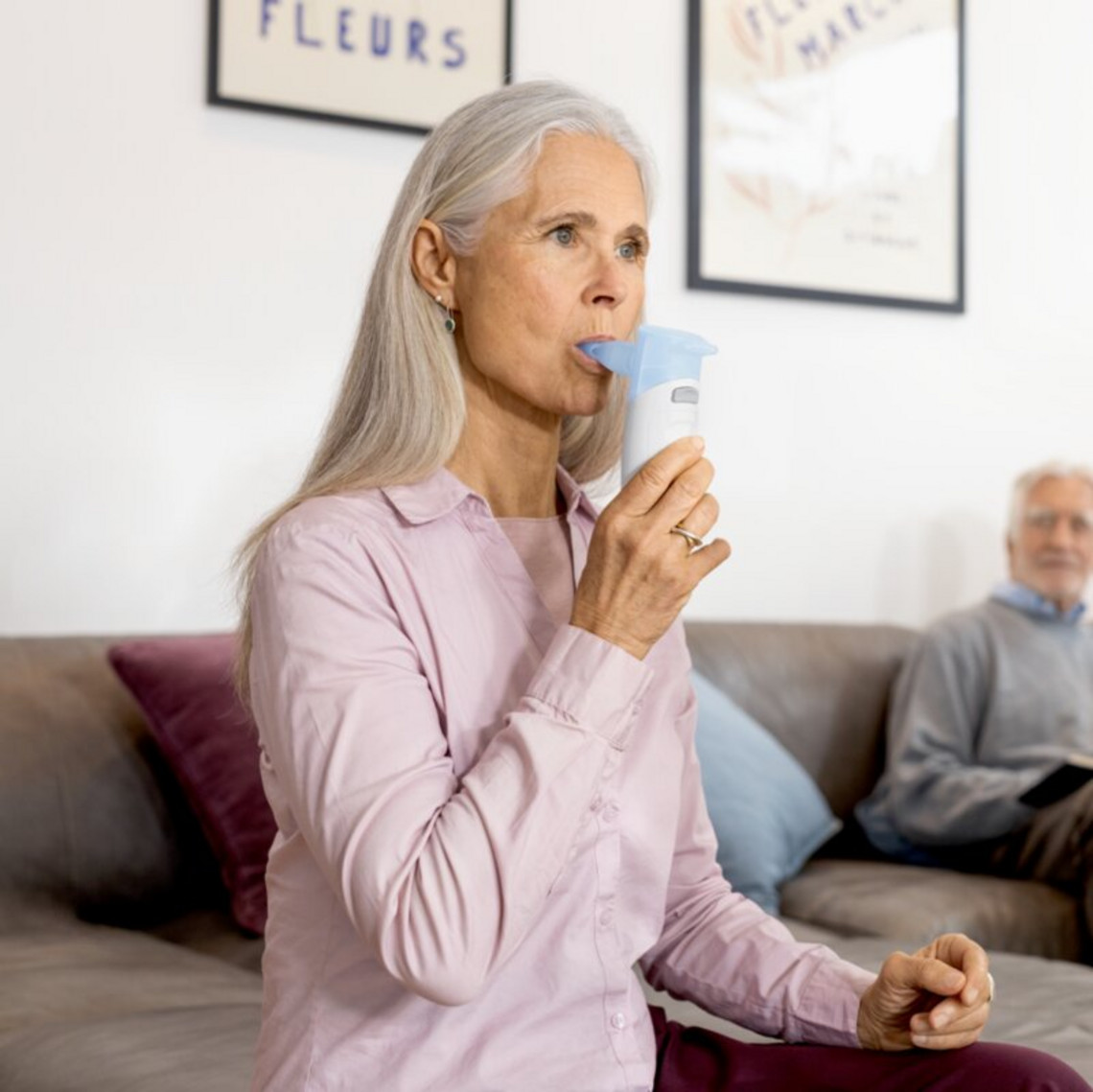
Prof. Fischer: The inhalation device should generate fine droplets at a size of ≤ 5 microns so that they can reach deep into the lungs. The device should be powerful enough to nebulise 5 ml of solution in around 5–10 minutes – otherwise it will take too long to do the therapy. The parts of the nebuliser must be cleaned and disinfected regularly, either by boiling them or using a steam steriliser to ensure that there are no viruses or bacteria lurking in the parts of the nebuliser. The parts must therefore be suitable for steam sterilisation or boiling.
Essential measures:
Supportive measures (the experience of COPD patients):
Prof. Rainald Fischer is a specialist in private practice, with a subspecialty in lung and bronchial medicine, emergency medicine, sleep medicine and allergy medicine in Munich, Germany. Before that he worked as a Senior Physician at the Munich University Hospital. Prof Rainald Fischer is a founding member and president of the German Society for Mountain and Expedition Medicine, and also a member of the German Cystic Fibrosis Medical Association.
Note: The information in this blog post is not a treatment recommendation. The needs of patients vary greatly from person to person. The treatment approaches presented should be viewed only as examples. PARI recommends that patients always consult with their physician or physiotherapist first.