
The term "asthma" refers to a form of persistent inflammatory disease affecting the airways. Asthma causes the bronchial tubes to narrow, which leads to tightness in the chest and episodes of respiratory distress. Typical complaints are shortness of breath, wheezing and coughing. These symptoms often occur at night and in the early hours of the morning. What is characteristic is that these changes are variable and reversible. If asthma is managed properly, these symptoms can be controlled – however, there is no known cure for asthma.

Asthma is a reversible, chronic disease involving the airways that carry air in and out of the lungs. The airways of people with asthma become inflamed. The inflammation makes the airways very sensitive and they often react to allergens or irritations.
There is no cure for asthma. But with the proper medication and a management plan, symptoms can be controlled.
Asthma can be triggered by allergens such as pollen, animal dander, or dust. People can develop asthma as children or adults. Childhood asthma and adult-onset asthma have the same symptoms, and both have similar treatments. Asthma can also be triggered by upper respiratory infections, cold air, exercise, air pollution, or changes in weather.
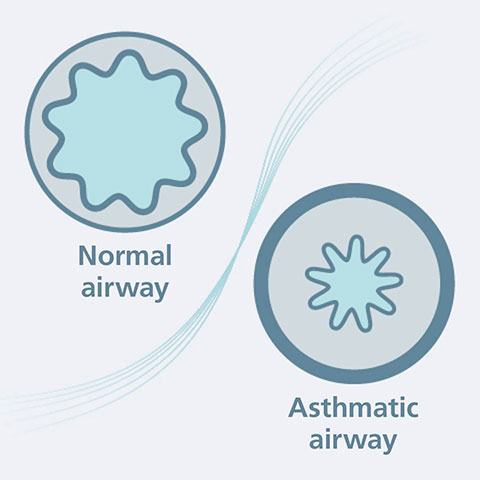
The typical signs of asthma can be described as follows: Attacks of breathlessness that usually occur at night. There can be wheezing or humming sounds, mainly when a person breathes out. Some people with asthma have a persistent cough. Others have no shortness of breath but a sense of extreme tightness in the chest or pain when they breathe in cold air.
Up to the age of 14, boys are more commonly affected by asthma than girls but the ratio reverses after this age. In some two-thirds of asthma cases the disease starts before the age of five. In about half of these children the asthma disappears before they are seven or over the course of puberty. The other half develops a chronic disease. Unfortunately, asthma symptoms are all too often overlooked in children. It is recommended that parents take their child to see a specialist if they suspect that he or she has asthma.

Many people with asthma underestimate the role they themselves can play in their therapy. Get educated about asthma! Asthma self-management education is essential to provide you with the skills necessary to control asthma and improve their outcomes.
The more you know about asthma, the better you can manage it. Self-help groups and patient training are a good way to find out more about how best to deal with asthma. Other people with asthma can also help by sharing day-to-day experiences, such as keeping asthma diaries and having an asthma action plan for emergencies.
If asthma is suspected, the doctor will first establish an accurate picture of your symptoms and will ask about your medical history including diseases in the family and allergies. This is followed by a physical examination during which the doctor will listen to your lungs for typical signs of asthma. A lung function test is required for a clear diagnosis of asthma. Further tests can rule out other diseases or, in the case of allergic asthma, can determine what the triggers are.

In this test, the patient blows into a mouthpiece with a special measuring device. This gives the doctor information about the volume of air you are breathing and lung function. If the lung function test indicates decreased airflow on exhalation, the patient inhales a medication to expand the airways. If there is an improvement, an asthma diagnosis is confirmed. If the test is normal, but asthma is still suspected, a provocation test can be performed.
Asthma can be triggered by allergens. A physician may do skin and blood tests to confirm if a person has allergic asthma. The prick test involves applying tiny amounts of common allergic substances to the skin of the lower arm. A blood test is also helpful to confirm allergic triggers.

If the standard tests do not clearly confirm asthma, an X-ray may be helpful to rule out other lung diseases. A blood gas analysis also gives information on the gas exchange in the lungs: it shows if the delivery of oxygen and the exchange of carbon dioxide in the lungs is working properly.
You can actively manage your asthma symptoms to enjoy a full and active life. The goal is to prevent long-term (chronic) symptoms that interfere with daily living, such as coughing or shortness of breath during the night or after exercise.

Your asthma is under control when you experience very few symptoms throughout the day and you can perform daily activities without shortness of breath, chest tightness, coughing or wheezing.1 You should be able to sleep through the night without symptoms, have few or no daytime symptoms, exercise and complete your daily routines without using a quick-relief medication or using it on a minimal basis.2
Some of the ways to control your asthma include taking an active role by avoiding asthma triggers, using medication properly, working with a health care provider to develop an asthma action plan and having regular checkups.
It is recommended that every person living with asthma have an asthma action plan that is completed together with you and your health care provider.
An asthma action plan outlines the steps to prevent or manage an asthma episode. The plan is customized just for you or your child and often includes:3

Can asthma be cured? – There is no cure for asthma, but it can generally be well controlled. To control symptoms, people with asthma manage their disease by following a regular treatment routine that includes taking inhaled medications that open up and decrease inflammation in the airways. Avoiding asthma triggers is also important.
Inhaled medications to the lungs are the preferred way to treat asthma. The aim is to manage the disease by preventing asthma symptoms that are caused by tightening of the airways and inflammation.
Another group of medications for the treatment of asthma are the beta-2 agonists or bronchodilators. Short-acting beta-2 agonists are medications for sudden shortness of breath. Beta-2 agonists or bronchodilators are inhaled and expand the airways to make breathing easier.

If you know what triggers your asthma attacks, it is essential to avoid them. This does not only apply to allergens or foods, but also for irritants like cold air, fog or dust.
PARI’s expertise in aerosol science, superior device performance and proven track record with clinical trials for respiratory diseases like asthma, provide innovative and effective solutions for inhaled drug delivery.
*Measured with Malvern MasterSizer X at 50% relative humidity, 0.9% NaCl solution, inspiratory flow 20 liters/ minute, continuous nebulization, 23° C, fill volume 2.5 ml.
The contents of the PARI Site, such as text, graphics, images, and other material contained on the PARI Site ("Content") are for informational purposes only. The Content is not intended to be a substitute for professional medical advice, diagnosis, or treatment. Always seek the advice of your physician or other qualified health provider with any questions you may have regarding a medical condition. Never disregard professional medical advice or delay in seeking it because of something you have read on the PARI Site!
If you think you may have a medical emergency, call your doctor or 911 immediately. PARI does not recommend or endorse any specific tests, physicians, procedures, opinions, or other information that may be mentioned on the Site. Reliance on any information provided by PARI, PARI employees, others appearing on the Site at the invitation of PARI, or other visitors to the Site is solely at your own risk.