A blocked or runny nose is unpleasant whether it’s due to a cold, sinusitis or allergies. Here are some tips on how you can breathe freely again.
Most people have runny or blocked noses from a cold caused by a viral infection. If a runny nose just won’t go away and is accompanied by a feeling of pressure and a headache, it might be due to sinusitis (inflammation of the nasal sinuses). If you get a runny nose every year in the spring or summer, accompanied by sneezing and itchy eyes, you could have hay fever (allergic rhinitis). If you suspect you might have sinusitis or an allergy-related runny nose, you should seek advice from your doctor or a pharmacist.

The bad news first – unfortunately you can’t speed it up if your blocked or runny nose is due to a cold. You have to wait until the virus has run its course. The body simply needs a certain amount of time to fight and eliminate the virus causing the blocked or runny nose. Once the germs have left your body, the problem of nasal blockage will automatically go away.
In contrast to a blocked or runny nose from a cold, time unfortunately will not cure hay fever or sinusitis. In those cases, it is highly recommended to see a doctor so they can determine the cause and prescribe the appropriate treatment.
But now the good news there are definitely things you can do to reduce the unpleasant symptoms of a cold, such as a runny or blocked nose and sneezing.
Regardless of the cause of the nasal congestion, these 6 tips can help you breathe freely out of your stuffy nose again.
Nasal congestion is sometimes accompanied by a sensation of unpleasant or painful pressure in your head. This feeling of pressure is caused by nasal mucus which does not drain out well enough. By doing a couple of simple steps you can promote mucus flow and ease the feeling of pressure in your head. Physiotherapist Marlies Ziegler, who often treats patients with nasal problems, is familiar with the acupressure points for nasal congestion and a feeling of pressure.
“I have had good experiences with acupressure for patients with cystic fibrosis, patients with rhinosinusitis and patients with nasal polyps. I give them acupressure as ‘homework’. The patients often report back that this often reduces their symptoms and discomfort. I myself use the acupressure points when I have nasal congestion from a cold. It provides short-term relief and improvement.
It is normal for it to hurt a bit when applying the acupressure, especially with nasal congestion. But afterwards there is a feeling of release, and it may feel warm to the touch. In acupressure or acupuncture for nasal congestion these spots are often worked in combination with other pressure points. Acupressure stimulates blood flow, which can trigger the positive effect.”
Marlies Ziegler
Physiotherapist
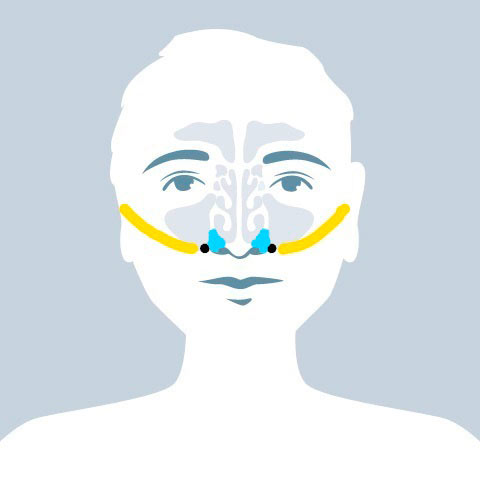
The LI 20 or Long Intestine 20 point is located next to the nostrils at the base of the nose. Press this point or massage it with your index or middle finger for half a minute. Repeat several times a day as needed.
Use a finger, for example your index finger, to feel the bony edge of the nose at the side of one nostril. This is the part of the nose where the soft cartilage ends and the hard bone begins. Press your fingertip against the bony edge of the nose. Imagine that you want to grip under this edge with your finger. Then stroke along the bony edge of your nose. Do these steps on both sides of the nose, one after the other. Each side can take 20 seconds or longer.
With one or more fingers sweep along your cheekbone from your nose to your ear. Firmly sweep along the bone, staying in contact with the bone as firmly as possible. This sweeping motion works, like other acupressure movements, because blood flow is stimulated in spots where nasal secretions are trapped.
The use of saline nasal sprays is recommended for mild colds or to prevent the nasal mucosa from drying out. Dry mucous membranes should be avoided, since they are more susceptible to cold viruses. When using a nasal spray you should make sure you buy a product which does not cause drug dependence so you can use it for long periods.
“Sprays with a dependence effect are mostly decongestant nasal sprays. They should only be used for a short time and/or only when advised to do so by a doctor or pharmacist. The sprays can also be used to open up the connection between your nose and ears. This allows fluid, such as that which forms when you have media otitis, to drain out of the ear. For a ‘normal’ cold, soothing nasal ointments and nasal sprays should suffice.”
Marlies Ziegler
Physiotherapist
One way to open up your nose and sinuses is to use special nebulisers for the upper airways. Physiotherapist Marlies Ziegler is familiar with these devices because some of her patients rely on them. She says:
“While inhalation with a special device for nasal inhalation like the PARI SINUS2, would surely be helpful for a normal cold, it would be ‘using a sledgehammer to crack a nut’. But for patients who have chronic nasal congestion and nasal problems, pain or nasal polyps, then I heartily recommend nasal inhalation with this device. It transports the inhalation solution via sinus waves into the sinuses. This helps the inhaled solution better liquefy the mucus trapped there. For patients with chronic rhinosinusitis, cystic fibrosis or sometimes even patients with nasal polyps, the PARI SINUS2 is often part of their treatment regimen.”

If you opt to blow your nose into a tissue, make sure you do the following:
If you sniff up into your nose the following is advisable:
The best thing, however, is not getting a cold at all. To prevent others from catching colds, it is recommended that you throw away used tissues straight away and wash your hands thoroughly every time you blow your nose. Of course, nasal congestion caused by allergies is not contagious. And chronic sinusitis is contagious only under certain conditions.
Note: The information in this blog post is not a treatment recommendation. The needs of patients vary greatly from person to person. The treatment approaches presented should be viewed only as examples. PARI recommends that patients always consult with their healthcare professional first.
An article written by the PARI BLOG editorial team.
© 2026 PARI GmbH Spezialisten für effektive Inhalation
